
Season 5, Episode 22: “The Body Keeps the Storm” with Clayton Aldern
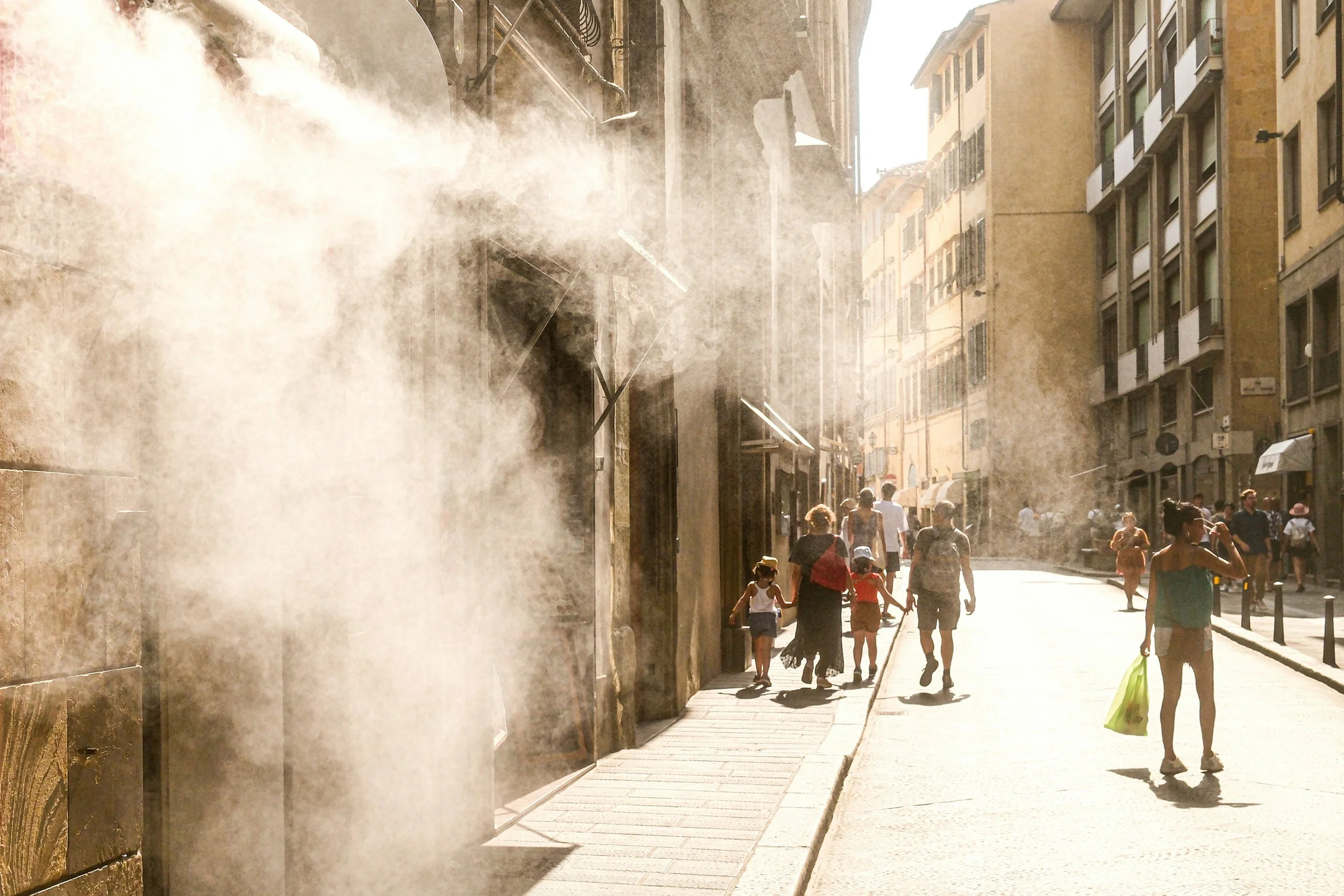
image credit | Richard Vanlerberghe
Season 5, Episode 22: “The Body Keeps the Storm” with Clayton Aldern
Climate change is not just happening around us, but also inside of us. Thomas and Panu join journalist Clay Aldern who explains how heat, storms, and other climate shocks can shape our minds and bodies in surprising ways. Their talk focused on climate trauma, eco-anxiety, and epigenetics — the idea that stress can leave marks on our biology and may even affect future generations. As Clay noted, “The climate’s always kind of reaching in and adding a little more weight.” This captures the episode’s core message: the environment is not distant; it is part of us.
This episode is very relevant for anyone trying to make sense of climate stress about summer heat.
Links
Yoko Nomura (2019) Children of Superstorm Sandy Study)
Heat and (Mis)Preceptions
Marlon, J.R., Begotka, N., Preston, A. et al. (2026). Experience-driven perceptions misalign with assessed heat risk in the United States. Nature Communications
Heat Risk Perception Map Yale Program on Climate Change Communication
Heat and Aggression
Kristen French (2026) Heat Probably Doesn’t Make You More Aggressive: An interview With a Behavioral Economist About Cake, Climate Change, and Cooperation. Nautilus
Craig Anderson (1989) Temperature and aggression: ubiquitous effects of heat on occurrence of human violence. Psychological Bulletin
Resources
2026 Rachel Carson Award to Ferris Jabr - Becoming Earth
GRIST News Climate and Data Desk “The only newsroom focused on finding solutions at the intersection of climate and justice.”
Earlier CCH Episode:
Transcript
Transcript edited for clarity and brevity.
Doherty: Well Hello, I'm Thomas Doherty.
Pihkala: And I am Panu Pihkala.
Doherty: And welcome to Climate Change and Happiness. And this is our podcast, a show for people around the globe who are thinking and feeling deeply about climate change, obviously, and other issues which could include politics or the natural environment or your life or your family or the season. This episode should be coming out in the summer of 2026 and we are really lucky to have a special guest with us today.
Aldern: Hey, my name's Clayton Aldern and I'm a senior data reporter at Grist and occasionally I introduce myself as a recovering neuroscientist.
Doherty: Great. yeah, I met Clay at the Northwest Science Writers meeting this past January and we traded books. His book The Weight of Nature has recently won a Rachel Carson Award,
Aldern: Yeah, well second place. I was a very happy first runner up to Ferris Jabr who took home the gold,
Doherty: Yeah. well that's tough competition. That's tough composition. I know Ferris a little bit as well. But Clay is an interesting person. He's a data journalist and wrote a weighty book on the weight of nature and it's actually stuff that we talk about here in terms of how our being on the planet affects our bodies and our minds and how we think about this stuff and how it affects our very sense of self. So we're going to get into some of that here. Panu, do you want to get us started?
Pihkala: Warmly welcome, Clay, also on my behalf. Lovely to meet you and discuss with you about the inner and outer impacts of climate change. And of course, these are interrelated. But it would be lovely to hear something about your background. How did you become so interested in climate related things and working heavily with them?
Aldern: Yeah, happy too. It it's a little bit of a circuitous path. I was in grad school for neuroscience about a decade ago when I came across a paper that somebody showed me illustrating the relationship ostensibly between climate and conflict. You know, this this kind of econometric study or behavioral economic study that'll occasionally come out of econ departments that that Illustrates that even if you correct for all the sociodemographic variables under the sun, all the confounders that you can think of, there still seems to be some kind of marginal relationship between heat and the risk of violent crime in some capacity, or indeed in this case the risk of conflict, right? Interpersonal conflict, both at the individual level and indeed the neighborhood or the state level.
And as a as a practicing neuroscientist at the time, this the kind of thing that sets off some alarm bells, right? Like, well, if we can parse out all of the potential confounders, and there's still some marginal effect here, relating temperature to behavior in the specific manner. Like, what is going on? And I kind of just couldn't get this question out of my head. I ultimately wound up doing a master's in public policy, kind of running away from academic neuroscience with my tail between my legs a little bit. but it was really a means to think about how I might move a little closer to a practice in which I was grounding the science I was interested in conducting in what I considered to be the real world, right? Or the social realm.
I'd been studying science for who knows, a decade or two at that point. And I didn't know anything about government or how people worked in practice. And so I wound up studying climate change and security as part of this policy degree. This is in 2015 because of this connection that seemed to be flourishing under the surface in some capacity. And it's been over the past ten or so years that I've indeed tried to move away from the lab per se and out into the real world thinking about the manners in which science works to affect real people, right? Biological processes are bearing out in our bodies all the time. Obviously these questions bear on policy design decisions, policy analysis decisions. And so I've kind of seen the project writ large is one that you know seeks to take the methods of neuroscience and indeed computational neuroscience and the tools of the trade when one's thinking about scientific literature review but then zooming the lens out and really seeking to ground some of these effects translationally, thinking about the manners in which the science in the lab has relevance for real people.
That's kind of been the project of my past decade. And it's led me through journalism, it's led me through the public sector. right now I run the data desk at grist.org which is the United States' largest environmental magazine. we work on climate change and environmental justice and energy justice. And at some point an editor said to me, hey, you know, you have this background in neuroscience. You really should do “this is your brain on climate change” kind of a thing for us. And I was skeptical at the time, despite having seen the occasional study here and there, but as I started to pull at these threads more and more, it became clear that there was a lot of meat on this bone, that there was specifically an intersection worth noting between a changing climate and a changing brain. And so the book that Thomas mentioned is the result of that research effort and it's an attempt specifically to ground the science of climate change in our neurobiology.
Doherty: Mm-hmm. Panu, why don't you follow up again? You have another question you often ask people in our episodes at the beginning.
Pihkala: Yes, very interesting to hear about that Clay and that kind of book has been much in demand. So really happy that it's out there. When you think of even earlier past in your life, did you have some things which you later have connected to this interest in climate matters? Were you one of these people who go out a lot into the nature or the modern human world? Or is that something which has come only later in your life?
Aldern: Well it's interesting you ask because I think if you would have asked me a couple months ago I might have said something like, Well, I don't know, I I'm from a rural community, I spent a lot of time outside as a kid. Certainly I have some relationships with place and with places that have changed and those relationships are such that certainly they spur some kind of interest in a changing environment.
But I actually found something in my childhood bedroom just a couple of weeks ago that I think tells the tale a little more specifically. It was the school assignment, which I have no hope of remembering being assigned, was probably in first or second grade, in which we had to design some kind of campaign, I think was the gist. you know, we had to be an activist in some capacity. and mine was all about saving the penguins. I don't think I really got the location correct. I think I dropped them in the Arctic as opposed to the Antarctic and I there were there were quite a few misspellings, but the gist was that I was interested in conservation. I have no memory of having explicitly been interested in conservation at like age ten, but I do have the receipts to back it up and my father was an environmental activist, which again is not really something I knew or understood growing up. He passed away when I was three years old. but over the course of my life my mother has mentioned to me his work you know with the Sierra Club, for example. He worked on Paul Wellstone's campaign, who is a senator from Minnesota, and certainly a senator who thought rigorously about environmental issues. and I think there was some triangulation there in my father's life when it came to thinking through his own environmental activism. So who knows if there was any kind of epigenetic inheritance on that front. I again, you know, wouldn't boast any knowledge of these things growing up, but maybe through osmosis they made their way in.
Pihkala: Thanks for mentioning and the human brain is very complex.
Doherty: Yeah. Yes, the human brain is complex. but what was your father's name, Clay?
Aldern: Brad.
Doherty: So here's to Brad. Father's Day is coming up this summer. So you know, honoring our people. I do think that I personally have in fact even somewhere in my office I have this three-piece poster thing from elementary school. I studied electricity, so I had like eel solar farms and various things. And so yeah, I think almost all of all of us, that's the uniform takeaway when I have people do an environmental identity exercise or thinking about their timeline. Almost everyone goes back to find things from their childhood that, if you're born after nineteen sixty-five, you're going to have that somewhere in your schooling because it was just part of the part of the culture. Yes, that's great. Brain on climate change, let's talk a bit about your book. It's a great book. It's juicy. It goes really deep. Well, I mean, I think you're a great writer, Clay, and you also just bring in literature and philosophy and you go into depth on these things. But I love chapter six. Maybe you could tell us about chapter six, The Body Keeps the Storm. I love that title. And, you know, we had talked about we've been talking about preparing for the summer here and potential heat or fire or things like that. But what would you what were you where were you going? Do remember where you were going with that particular chapter? And I think there was a fire in Gatlinburg.
Aldern: Yeah, yeah. Happy to discuss. you know, in in fact it's kind of funny I just made a reference to epigenetics because I think one of the biggest takeaways in that chapter is indeed an epigenetic takeaway. So maybe that's a nice place to start. The kind of gambit of the chapter is indeed in the title, right? It would it would say that we don't need to go to war to experience PTSD, right? The violence of a hurricane, or indeed a wildfire, or a severe drought, right? That enough. These climate shocks, the climate trauma that results from these brushes up against this violent world, they're enough to seed the symptomology of post traumatic stress disorder. And so the chapter seeks to understand what it is about climate trauma, if anything, that makes it unique and what are the effects, intergenerationally included, of experiencing it? the reason I mentioned the last part is indeed because of this this this epigenetic bit. So maybe I'm kind of giving away the punchline here, but by way of illustration, you know, one of the studies I discuss in that chapter comes from Dr. Yoko Nomura, who's a neuropsychologist at CUNY Queens, and when Hurricane Sandy rolled into town in 2014, she was in the middle of conducting this huge cohort study of expecting mothers called the Stress in Pregnancy Study. And Dr. Namura was interested in getting a sense of all the various exposures to which expecting mothers might be subject, and indeed tracking the relationship between these kinds of exposures and maternal child health outcomes in the decade of life or so. Probably misquoting there a little bit, but that's the gist. And so indeed, Hurricane Sandy, unbeknownst to all of them in the study, waltzes into New York and all of a sudden Dr. Namura has effectively two cohorts instead of one, right? There are mothers who were pregnant at the time of the storm, right? So you had fetuses that were exposed to sandy in utero effectively. And then you had mothers who had either given birth before the storm or indeed conceived after.
And so what Dr. Namura did was indeed follow this cohort-based approach and after the children were born in in each case, track these same outcomes over the first ten years or so of life. And lo and behold, what do you find by preschool age, you know? You know, ten and below, we're talking about things like in the exposed cohort, right, the children who experienced Sandy in utero and then grew up having had that trauma when they were still in the womb. By that preschool age, you see an increase in in major depressive symptomology, anxious symptomology, things like conduct disorder, ADHD. and we're not talking, you know, two percent more likely or three percent more likely. These are these are like 10X, 20X, 30X likelihoods that we're witnessing relative to those who were not exposed to the storm.
And so there's a great question here, which is why? How? How is this possible? And Yoko Nomura would say is stress can be and indeed is inoculating during gestation, right? The world is a stressful place. It would behoove us to be exposed, right? For our developing brains to be exposed to the kinds of glucocorticoid storms, right? To the kinds of stress molecules to which they will be subject later in life, right? If we were not exposed to any stress whatsoever that would not be preparing us for the way that the world is. So stress in pregnancy can be a good thing. And indeed, in these kind of inoculating doses, it is. The problem is that everybody has a breaking point. And if one experiences something like a hurricane, lo and behold, the effects are going to be pathological in nature. And where the epigenetics comes in here is that unfortunately, because we're probably talking about epigenetic changes, because we're not necessarily talking about a genome being altered in some capacity, but rather we're talking probably about protein expression. We're talking about genes kind of being upregulated and downregulated as a function of stuff like methylation sites. When that happens and you see the behavioral phenotypes that we observe in studies like these.
There are more alarm bells going off because unfortunately epigenetic changes are heritable as well, which means the children that we're seeing with these elevated risk profiles are likely to pass on those same epigenetic markers to their children. So now we're talking about this kind of intergenerational memory of climate trauma being imprinted in this kind of neurocognitive or neurobehavioral capacity. down the line. When of course the, you know, hypothetical grandchildren in question didn't have anything to do with this storm. And so that's what this chapter is about. It's about all the manners in which our bodies encode climate trauma in this manner.
Doherty: Mm. Yeah. For our listeners who aren't versed in neuroscience, do you want to give an accessible explanation of epigenetics?
Aldern: Yeah, sure. So I mean this is a this is a relatively new field, all things considered, of science. You know, it's kind of the it's the system of like chemical annotations layered on top of your DNA. and indeed controls which genes get switched on or off without changing the underlying genetic sequences. So you can kind of think of it as the software settings on top of the hardware of DNA. and it and it basically helps decide which parts of the hardware actually run in a given cell at a given time. that's kind of the core idea. There are a handful of ways these kind of these chemical annotations work. I mentioned DNA methylation being one of them, which is basically the idea that you have these control regions on genes that can that can be tagged. And if they're tagged with methyl groups, a type of chemical, effectively you have the silencing of a gene, right? The cellular machinery all of a sudden can't easily access the DNA to read it because it's kind of been covered up by these methyl groups. Methylation is almost like a dimmer switch sitting on top of these specific genes. And again, I you know, in terms of the study I'd mentioned, I don't think anybody's actually done the relevant epigenetic work to see what's happening in in in Yoko Nomura's Cohort's case. but one can imagine it's probably something like this, because effectively there aren't too many alternatives.
Doherty: Yeah, yeah. Well this is fascinating. I mean, there's a lot of directions to go. I mean what it what it brings to mind to me this idea of eco anxiety, we talk about climate anxiety, where one worries about the climate, but eco anxiety originally was talked about in in relation to chemicals in the environment. That’s my understanding of how the term was first used in the media around endocrine disrupting chemicals. But it's sort of like this epigenetic stuff in the sense that part of the heart of eco anxiety is that it's these small kind of mysterious processes in the world, in the environment, in our bodies, in our DNA. Out in the world, chemicals that are just hard to hard to pin down and it's hard to find them. We know they're out there. It prompts this kind of like existential anxiety like I know a little bit about epigenetics but I'm like but really my DNA is turning on and off and from a storm and even though it's understandable and it's not a death sentence or it's not deterministic to who we are as people. It still feels that way to me, like it's threatening, like something's beyond my control. did you find some of that in your in your work or personally or in your writing?
Aldern: Yeah, I think I think the word control there is a big one for me. I frequently think about these effects, the relationship between a changing climate and a changing brain or a changing mind, in terms of control, in terms of loss of agency. I wouldn't say I'm somebody who subscribes to a particular definition of free will that's really getting too beat up here. and yet we love to imagine that we have something called free will. We love to imagine we are in control of our actions. But if I put twenty studies in front of you right now showing you that there's pretty reliable relationship between something like a temperature deviation and the likelihood of you maybe punching the person next to you on a bus, or yelling at the postal worker at the post postal office or offering up some act of online hate speech, which I imagine you probably won't. and yet we know that at the margins, all of these things increase in likelihood with higher temperatures relative to what one traditionally experiences. So where's the free will there, right? We have evidence that the environment reaches in and tips the scales.
That is part of the gambit of the title of my book, right? It's I'd argue that the environment is always kind of reaching in, the climate's always kind of reaching in and adding a little more weight, right? Forcing your hand a little bit in a certain direction. And it's usually imperceptible. I don't think that it's impossible to you know, train ourselves to recognize these moments. But for the most part they operate subconsciously. We are these billiard balls that are constantly being bounced around by our environmental conditions. And indeed that's what helps us survive, our ability to respond to the environment. But lo and behold, there's a narrative here that says, well, as the climate forces our hand in these manners, we are subject to less and less control in the way that we tend to imagine.
We are in the first place. it's I think a motif for me that runs through a lot of this literature, the notion of a loss of agency. Right? We think about that a lot in the eco-psychology literature. We think about you know when it comes to something like eco anxiety or climate anxiety, these you know depressive or kind of ruminative effects where if you are staring down the barrel of this doom.
Doherty: Mm-hmm.
Aldern: You know, the thing that you wind up doing is just not wanting to get out of bed. unless you have some route to action, right? Unless you have evidence that the efforts that you're putting forth matter in the first place. Without evidence of that action though, you don't feel you're in control. And lo and behold, we observe the deadening depressive effects of climate anxiety.
Doherty: Mm-hmm.
Aldern: when there is no evidence of control.
Doherty: Yeah. Yeah. So climate anxiety and climate grief or depression, you know, tend to go hand in hand for sure. Yeah, what are you thinking, Panu?
Pihkala: Yeah, thanks a lot for all that. That's very important and points to some key existential lessons and challenges of this time, but perhaps also some previous times that accepting that humans have influence on things, but humans are not really ultimately in control of everything. And this of course is related to notions in Western culture and science about how much in control we can be and how much dominion we can have and so on. So it's a tough lesson to really accept that we can do things but we also have to live with uncertainty and course uncertainty and uncontrollability are key elements in anxiety research.
A friend and colleague of mine did a series of radio programs and talks called Climate Change in Me in Finnish. So that's what I'm hearing here. That's how climate change is in us and in us all. How are you personally coping with all this, Clay, may I ask?
Aldern: Yeah. Mm. Mm. Yeah. Well, no longer seeking to compartmentalize between climate work and the rest of my life. I think for a very long time I went to work as an environmental journalist and my day job was writing about the apocalypse and then I would go home and kind of turn that part of me off and try to cook dinner and have a normal life and see friends. And you know, there was a there's a day I was reporting this book in which I was reading this study about you know increased COVID mortality rates as a function of point source emissions. Right. There was this moment in the United States early in the pandemic when enforcement of EPA regulations was cut such that you saw an increase in these kind of smokestack emitters all around the country because nobody was inspecting these facilities or checking permits or whatever the case may have been in a given facility. And the study was a follow up that said, well in the counties where that was true, do we see kind of any effect on COVID mortality? And, you know, of course it's a respiratory disease. Like lo and behold, in the areas in which a lack of enforcement was related to an uptick in emissions, you also saw an increase in COVID mortality. And I just remember reading this paper and being like so depressed as if I was like, this is rough, this is really rough. I like I got to take a break. And I kind of shut my computer and looked out the window. And you know, it's like 2021-2022, the sky is completely orange because it's summer in Seattle and there's a wildfire outside and it's like raining smoke, excuse me, raining ash. And there was you know, there was no escape. It was it was just the weight was right there. You know, I was feeling the weight and it was such a reminder that there is no compartmentalization, that by definition, the climate is here all the time.
You know, we are enmeshed in our environments, to borrow a word. and of course it has always been and will always be that way. And so, you know, Panu, to answer your question, you know, how am I coping? I I'm seeking to remind myself that there is no compartmentalization, that there is only enmeshment, and that the best we can do is notice the manners in which the enmeshment is bearing on our internal experience and indeed our actions, our behavior, our mental, emotional, spiritual health. I'm mostly trying to be pay better attention to those effects and I think it is with this this kind of mindful presence, with this grounded attention that we can indeed perhaps regain some of the loss of agency, some of the loss of control that we were just talking about in in in the previous segment.
Doherty: Yeah. This is really great. so we could go in a lot of directions. I want to just show in a couple of things and then we'll toss it back to Panu. Yeah, Craig Anderson, the psychologist, when I started studying environmental psychology, that was one of the first strongest findings in environmental psychology is that heat is related to violence. and so it's a really standard understanding. But I also I think it's nuanced. for listeners, it doesn't mean that just because it's hot you're going to go beat up people. I think part of the heat thing, and we maybe talk about this again another time, is that it's also heat relative to what we're used to. Like a heat wave just on its own—many places have hot temperatures all the time around the equator—It doesn't mean that those people are inherently violent. We have to be careful of these cultural stereotypes too. But I do think it's when heat pushes us out of our comfort zone when we're not used to it. And then socio economically we don't have air conditioning. We don't have trees.
So it's complicated. It it's not it's not you shouldn't be afraid of hot weather in a very simple way. It's just again something that we have to you know, part of this big piece we were talking about before the episode is that people just don't anticipate how hot weather can be in the modern world. It's hotter than it has ever been in thousands of years. And so we whatever we think is hot weather, you know, if you're not thinking big enough, as I say. So it's going to be hotter than you think. So this summer we have to be aware that this temperatures can push us way out of our comfort zones, make us uncomfortable, angry, depressed, and we have to think about caring for people and finding people that are needing cooling and so there's a lot of you know inspiring pro social things to go with this in in addition to the hard feelings. I just want to make sure we throw that in there here. but I'll be quiet for now and I'll leave it to you both to help us wrap up today here.
Aldern: Well, you know, you mentioned comfort zones, right? Which is such a reminder, again, to me, of the underlying biology, right? And it's one of the reasons why those deviations away from normal do matter so much more than absolute temperatures, right? I think I you're spot on to point at the risks of a frame that says temperature is all that matters, right?
Pihkala: Hmm.
Aldern: Social Darwinists loved that idea. It was it was the excuse that one could make to basically you know argue that people who live on the equator are lazy. but it's not what the evidence shows. The evidence shows that it's relative deviations that matter, that it's movement away from one's comfort zone. Why does that make sense? Well, because bodies are always seeking to maintain a homeostatic set point. And we know, when we have moved away from our set point. That's what discomfort is. So I would just you know underscore that comment that discomfort is part of the story here. Discomfort is our body telling us something, right? So when I when I speak about in this kind of mindful attentiveness to our own experience I think it's I think it's you know worth
Doherty: Mm-hmm.
Aldern: underlining this this notion of affect, worth underlining this notion of the kind of internal experience of the environment. Because if we can pay closer attention to how we are feeling in this world, I think we have a better chance of responding to those feelings in the way that we would prefer more frequently.
Pihkala: Thank you, Clay, wonderfully.
Doherty: Yeah. For sure. Well, this is wonderful. Panu, yeah.
Pihkala: Yeah, in pedagogy and environmental education there's a strand called pedagogies of discomforts. So the idea is that we need to encounter the discomforts and then find ways together to live with it and encounter some hard truths and then find ways to practice compassion and life together after that.
Acceptance is key there. I think also, as you say, to quote Trebbie Johnson, one of our earlier podcast guests, acceptance is not surrender. So it doesn't mean that we just let everything happen, but we can accept what we need to accept and then try to be conscious and flexible in our choices. The listeners, The Weight of Nature by Clay is in bookstores. We'll put links to the show notes as usual. We have to wrap it up here even though there would be a lot to talk about these things that we have just put on the table. But warm thanks on my behalf, Clay, for joining us.
Aldern: Yeah, thanks so much for having me.
Doherty: Yeah, thanks Clay. I look forward to more dialogues. I love that this is an invitation for us to be gentle with ourselves, to take care of ourselves and others in in this hot weather, particularly when it's a heat wave that we're not used to. and Clay, thanks again for your time.
Aldern: Thanks for yours and thanks for your work.
Doherty: All right. Clay, Panu, and listeners, everyone, be well and take care of yourself.