Season 5, Episode 19: On A Career in Climate Wayfinding: With Katharine Wilkinson
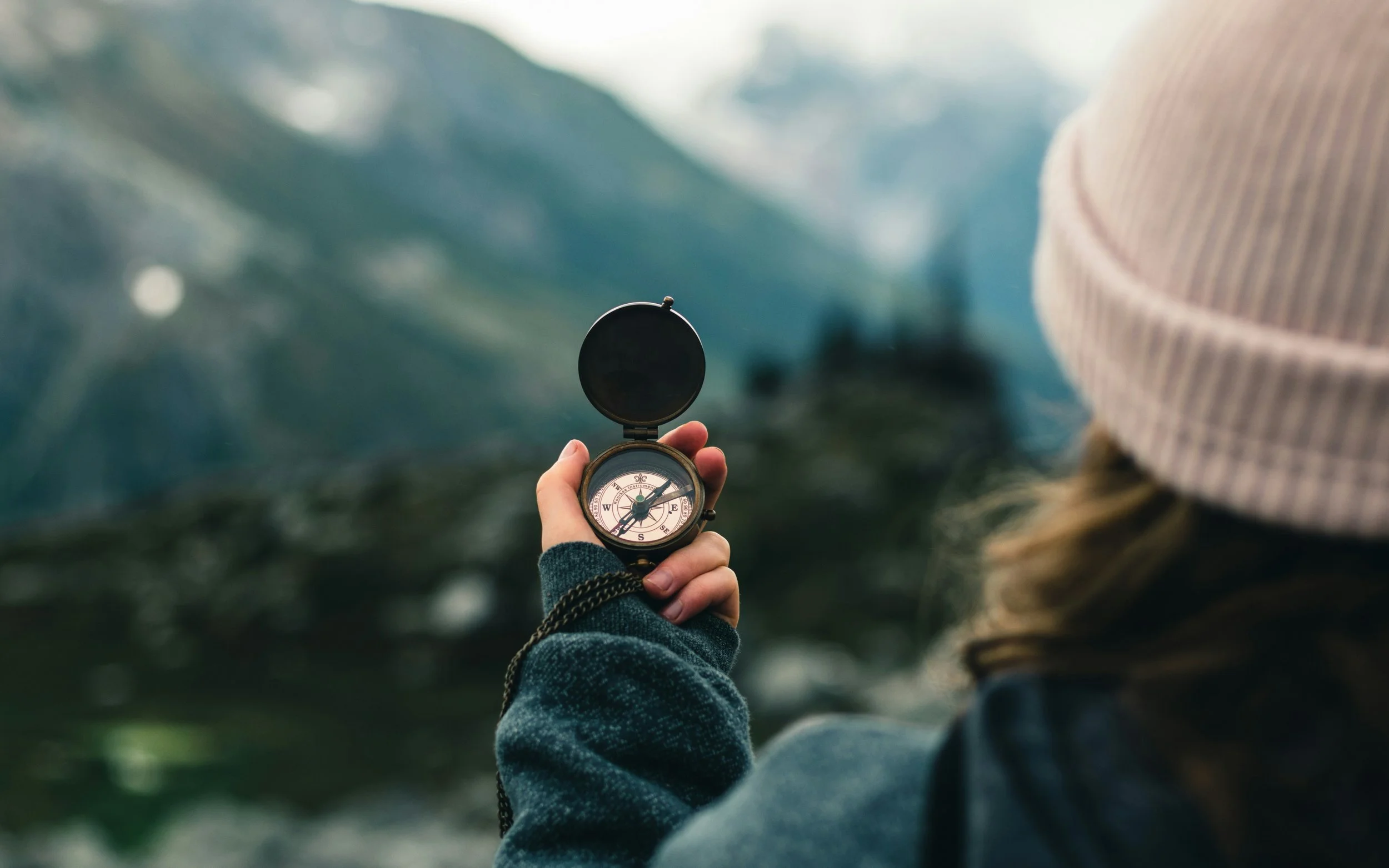
image credit | Ali Kazal
Season 5, Episode 19: On A Career in Climate Wayfinding: With Katharine Wilkinson
Join Thomas and Panu to listen in on their great conversation with Katharine Wilkinson who reflected on her career as a woman working in climate science and policy, and how she reached back to her roots with her latest book and program Climate Wayfinding.
“Sometimes I think the paradox of calling is that we have certainty and uncertainty in the same breath.”
— Katharine Wilkinson, from the episode
Links
Books
Climate Wayfinding (2026)
All We Can Save, (2020) a collection of writings by 60 women leading on climate, co-edited by Ayana Elizabeth Johnson and Katharine K. Wilkinson
Between God and Green (2012)
Transcript
Transcript edited for clarity and brevity.
Thomas Doherty: Well hello, I'm Thomas Doherty.
Panu Pihkala: I am Panu Pihkala.
Doherty: And welcome to climate change and happiness. This is our podcast, the show for people around the globe who are thinking and feeling deeply about climate change and other environmental issues, including your positive connections with nature and your values. This episode should be coming out in the summer of 2026. And we'll be trying to anticipate a little bit about what we're going to be finding in the summer. We are really lucky to have a special guest with us today.
Wilkinson: I'm Dr. Katharine Wilkinson. I'm a climate writer and teacher. I co-founded and lead the All We Can Save project and recently published the book Climate Wayfinding.
Doherty: Yeah, and we've been chatting with Katharine. Katharine is someone we don't know personally, but we know of professionally. Katharine is kind of a veteran of climate science and communication and more recently, public expression. She has her new book Climate Wayfinding which is really great and accessible. And she's been traveling around talking about this and we're really lucky to grab her coming in from her home briefly in Atlanta, Georgia. And I'm in Portland, Oregon, and Panu, as we know, is in Helsinki. Panu, do you want to get us rolling on our conversation today?
Panu: Warmly welcome, Katharine, also on my behalf. Lovely to meet you. We often start by asking something about the person's journey towards what they later became. Would you like to share something about how did you end up being so intimately involved with environmental and climate issues?
Wilkinson: Thank you, Panu, and thank you, Thomas. It's really a pleasure to get to have this conversation and get to know you both a bit beyond the work that you've done so brilliantly.
I think like a lot of people, my arrival into this work had educational roots. When I was a sophomore in high school, freshly turned 16, I spent four months at a wonderful experiential school called the Outdoor Academy in the Southern Appalachians in Western North Carolina. So I lived in the woods with 25 kids for four months and sustainability and ecology were woven into the ways that we operated as a community, what we were learning in the classroom. I started to read Mary Oliver's poetry. I read Daniel Quinn's novel Ishmael. But I was also having firsthand encounters with the ecological wounds of that part of the world. Mountaintop removal coal mining, clear cuts for industrial timber in the national forest.
And so I was both deeply enlivened by how we were living and what we were learning. And I was utterly heartbroken about the encounters I was having with the gap between the way that we can do things and the way that so often in dominant society we do things. And I still have the journal that I had at that time at the beginning of the semester—we all made a hand bound journal—and I can remember this absolute steadiness of hand when I wrote simple, but profound words “want to help the world, be connected with the earth, change the way I live.” And I remember just so much clarity and conviction about that.
Panu: Hmm.
Wilkinson: And I think sometimes the paradox of calling is that we have certainty. Sometimes I think the paradox of calling is that we have certainty and uncertainty in the same breath. And I had no idea what that would mean for my life moving forward.
Doherty: Hmm.
Wilkinson: And in a lot of ways, I feel like that was a moment of kind of setting the compass arrow, so to speak. And I've zigged and zagged through climate work now from those early days of youth activism for 27 years and counting. Yeah.
Panu: Warm thanks for sharing that, that's very inspirational and testimony to the power of these social experiences outdoors. So a nod to all of the folks around the world who are doing environmental education and outdoor education and all that stuff.
Wilkinson: It's so powerful.
Panu: And very often the impacts are seen only years and years later on or the full impacts. Of course something is visible right away and we have an earlier episode for example with Louise Chawla who has been researching these factors and moments and influences which cause people to go into environmental or nature-oriented trajectories and I hear very powerful ones here and also reminded of the saying by a woman from the east coast that “the world called and I answered”
Doherty: Mm-hmm.
Wilkinson: Yes, yes, yes, I do think there is there is a real calling that happens for so many of us and often it is a combination of heartache of some kind and enlivenment about the possibilities.
Doherty: Mm hmm. Yeah. that's wonderful. I think for our episode, since we have a lot of experience here, I think it's good for listeners to realize that what we see now is formed over many years of thinking in society. And even Daniel Quinn's novel, Ishmael, I haven't thought about that in a long time, but I remember reading that at one point. So there are novels and books, even like Katharine’s book or my book or Panu's work that people are reading now, but there were things that we were reading, you know, 20 years ago or 30 years ago that were influencing us. So it is like this long, long, long tradition of environmental protection that most people share, even though we forget that and don't see it. Yeah, there's so many directions to go, but I was curious, Katharine, to talk a little bit, if you wanted to reflect on the beginning of your career, because as we chatted earlier, women are in many roles of leadership now in the climate movement, either in science or policy, government, but that wasn't always the case. And it seemed like that was an explicit focus for you, or maybe you were pushing against some boundaries when you got started. Could you want to take us back in time? I think young people might find this interesting.
Wilkinson: And this is a fun invitation, Thomas. It's taking me back actually to a conversation I remember having with my first boss out of college. So I spent a year working for the Natural Resources Defense Council, one of the big environmental NGOs in the US. And was doing a lot of work on the ground in Southern Appalachia in Tennessee. And my boss was in New York, and I was up there for some meeting or another. And we went to have lunch and he said, you just need to get a PhD. It doesn't really matter what it's in, but you're going to need to have that for credibility in this space.
Doherty: Mm-hmm.
Wilkinson: And I think it's a testament to what the environmental movement was like at that time. And it really did feel like if you didn't have the bona fides, if you didn't have the research chops, if you couldn't come in with, you know, a PowerPoint presentation full of charts and graphs and data, you know, good luck claiming a seat at the table. And I did do exactly that. The following year I went to the University of Oxford and started work on a on a PhD.
And I did that kind of in my own funny, wildly interdisciplinary way, looking at what was at the time kind of a burgeoning—movement is too strong a word—but initiative around climate within American evangelical Christianity. So it was a mashup of public discourse and religion and politics and culture and very qualitative work.
Doherty: Mm-hmm.
Wilkinson: But I can remember coming out of that PhD and even after publishing my first book, which was an academic book called Between God and Green, and in some ways still feeling like I kept finding myself in rooms where I didn't feel like I could be taken seriously. And they were often rooms full of mostly men, mostly white men. And certainly, that is where the microphones were sitting. And some years into my own climate trajectory, I found myself feeling pretty darn frustrated about that as a matter of efficacy, as a matter of fairness, as a matter of honoring kind of the full suite of talents and wisdom that we have in this community.
And in 2019, Dr. Ayana Elizabeth Johnson and I were at a conference together where we were watching these same gender dynamics play out. And we said, we've had enough of these conference sessions. We went on a rage hike along a nearby river. And I shared with her that I'd been thinking about an anthology of writings on climate by women as a way to do sort of a collective chorus uplift, if you will. And that's the work that became the All We Can Save anthology that came out in 2020.
And happily, I think in the last now almost six years since that book came out, it has shifted. I think there is much better representation, but still if you look at boardrooms, if you look at national legislatures, if you look at the places where climate decision making is happening, we still aren't anywhere close to gender parity in terms of who is at the table making decisions about our shared future.
And when that is the case, we know that the outcomes for the planet are better from the community level to the national level. Certainly, we saw that in the Paris agreement negotiations when Christiana Figueres was leading those. It's still something that we need to continue to work on. And what's been interesting for me to reflect on with this new book is that I think in some ways I am reclaiming ways of knowing and things that I knew to be important in the earliest days of my own journey, whether that be poetry, whether that be centering the human spirit, whether that is the building of community. But it took me a long time to really hold and center that in my own work, because these are the things that are coded as feminine in our world, and thus often dismissed as “nice to have”. But really, you know, all the matters of the prefrontal cortex and things with hard numbers and linear trajectories, you know, are still often the things that are celebrated.
Panu: Hmm.
Doherty: Yeah, that's great. I mean, you're more secure, developmentally, that's what we also talk about that in our podcast.
Wilkinson: Yeah, but also but also more secure professionally, right? There was something about kind of earning my stripes maybe in the space that then made professionally safe to explore more of this terrain.
Doherty: Yeah. because if you had showed up with a poem and a playlist in those earlier meetings, it wouldn't have gone very well.
Wilkinson: Yeah, I really tried. I was the lead writer on the book Drawdown, and I really tried to advocate for including just one Mary Oliver poem in that book, and I was resoundingly shot down from that idea.
Doherty: Yeah. Hmm.
Panu: Too bad, too bad.
Wilkinson: I know we need we need the poets. We really do.
Doherty: Yeah. So it's going it's going both ways. I feel like I was at a climate week event in Boston and I was really thinking that they were missing just the arts broadly at the climate week. In terms of not just arts as entertainment but the arts as agents of change. We’re going in lot of directions in our society around climate. All of these trends about bringing women, and that is still true. Most of my training groups with therapists, many of my students, many of the climate psychology alliance people are women. In fact, I'd say it's like 80 to 90 percent women. So in certain areas of the climate movement, there are a lot of women leaders, women centric. But yes, as you say, at the true power seats of the table, the true decision making behind closed doors, it is still really an old boys club still to our detriment. It's easy to think that we've made progress, but, not in all areas. So that’s really interesting.
Wilkinson: I have to share one other gender observation from the book tour with climate wayfinding that has been very interesting to me that even in rooms that have been a really kind of beautiful representative gender mix, most of the men have walked out without the book.
Doherty: Hmph.
Wilkinson: And I think that I actually sort of challenged a group last week to say, you know, if you think that this book is not for you, there may be something in this book that people you work with need you to have, right? That stretching into these spaces of the body, the heart, other ways of knowing, other ways of engaging, that are not about sort of rational debate and laying out strategy, right? But bring in these other dimensions. You may not think you need them, but there may be people that you're working with that needs you to have them. And that was interesting. For a while, I thought, maybe this is just because of all we can save and, you know, kind of the centering of women and that work. But I kept seeing this gender dynamic come up that I found fascinating and a bit discouraging because I think we all need to be cultivating the full spectrum of our capacities in this time.
Doherty: Yeah, I agree. So you're privileged to get into some more high-powered group planning and things like that. So yeah, that's a paradox. I've been talking about with a lot of my climate therapy, climate psychology people, environmentalists pay lip service to the need for self-care. But when it comes down to it, they aren't necessarily the best at this. And they do revert to the science and the instrumental. My needs, my personal needs, are second, almost in a self-punishing way. That's a whole deeper level of this.
Panu: Yeah, that would be an interesting discussion of the psychological models which are often unconscious among various people in this case, environmentalists. And of course for men it's often a tragedy of socialization that there's been so little opportunities for practicing free somatic movement for example.
Doherty: Mm-hmm.
Panu: Or given credit for being sensitive with creativity and arts, for example. So, it's a big societal problem. There might be listeners who haven't checked out what climate wayfinding is about. So, in a nutshell, what is it about?
Wilkinson: Well, this is an excellent question. So, Climate Way Finding is a book that actually grew out of a program that we've been running at the All We Can Save project for the last four years that was designed to help meet people in this increasingly mapless world that we live in.
This is quite literally true as the climate crisis changes our physical landscapes, but it's also true for us that maps are coming up short internally, organizationally, culturally. Our ways of sense making and navigating are not working. And I think we hear that navigational challenge in the very questions that people ask, and especially in that persistent drumbeat of a question “what can I do? What can I do?” And over the years, I started to think about that question, to use a fungal metaphor as more of a fruiting body of bigger, deeper wonderings that people are holding, certainly that I myself experienced holding.
Doherty: Mm-hmm.
Wilkinson: And there are entirely too few spaces to take and hold those big questions. And to work our way through the ache, through the doubt, through the sense of isolation and overwhelm or burnout for folks who've been in this work for a long time and towards clarity and a sense of possibility, connection and footholds for forward momentum. So that's what we've been doing with the Climate Wayfinding program. And in its simplest terms, it uses a range of modalities to help people look inward with care, look outward with curiosity, and look forward with courage.
And we started piloting the program. then started training facilitators. It's running now on over 50 college and university campuses across the US and Canada, but we're a tiny nonprofit and the needs for wayfinding are not just for students, right? People of all ages and career stages and climate newbies and burned-out veterans. Like we're all trying to orient and navigate this very tricky time.
And I had kind of a hand to forehead moment of like, yeah, I make books. That's one of the things I do. And we could take the ideas and the content that had been developed for the program and bring it into a book form and not just a book that talks to you, but a book that will walk with you through this journey of exploration, bringing in, of course, bookie things like essays and poetry and stories, but also journal prompts, creative mapping exercises, guided meditations, and even a collective reading group experience. trying to put the journey of climate wayfinding in the hands of anyone with a library card and internet access.
Doherty: Mm-hmm. Yeah. I like integrated book groups really into the content and process of the of the book. Yeah, yeah.
Wilkinson: These questions are too big to hold alone. You know, we really do need to hold them together.
Panu: Yeah, and I love the metaphor of wayfinding for many reasons. One is that I have a long history with maps and orienting the sport where you run with the map in the woods and the idea is that it shouldn't be too easy or you lose interest to it. Well, one could argue that the global situation is a bit too difficult, but anyway, there's a certain dynamic of realizing that uncertainty is always there if there's possibility for something truly big and important. So, it goes to sort of philosophy of vocation and calling, which we touched on briefly earlier on. But if we think of landmarks or things that give us direction, what would you say are some of those? I know that you are writing about them in the book, but as a metaphor and a substance question, what helps us orient in this kind of world?
Wilkinson: So, I think about that inward outward forward as almost creating a kaleidoscope. And that moving through those three lenses kind of ongoing and cyclical actually helps us see more clearly the path ahead.
And of course, the looking inward is in part about the emotions that we bring with us to this topic that this topic brings up within us. You have both done such amazing work on that. I was delighted that we were able to include the climate emotions wheel in the book.
Panu: Mmm.
Wilkinson: And welcoming those emotions in not just as something inconvenient that we would very much like to settle or have go away, but as sources of guidance as teachers in a way as an expression of life itself kind of rising up within us that I think when held with support and compassion can become profound sources of direction about what matters and where we want to send our time, our energy. But we also do, looking inward at the unique expressions of life force we each bring to this wild party of being human on earth, which are the things that give us a sense of inner power and deep joy. And sometimes our gifts, I think, are very clear. And sometimes they have a way of being quite slippery or hard to pin down. And we use a process of kind of somatic reflection to identify those sources of power and joy and then use those almost as a portal to the gifts or the talents that we want to offer and boldly claim in this time.
Looking outward, of course, is in part about what the solutions are. And, of course, we need the mind of the analyst when it comes to solutions. We want to make sure we are steering towards things that could genuinely, meaningfully help. And there are some BS solutions out there in the world.
But my experience with Drawdown was that even when you bring the kind of best of the rational mind and good hard math, what is the toolbox of solutions look like? With our own discernment, it's still an overwhelmingly long list, right? You can flip through the pages of that book. There are a hundred different things, right? Where in the world do you begin? And so, we welcome in the looking outward, our sense of curiosity, wonder. Where does our energy steer us? Not just where does the good mind of the analyst take us? So, kind of melding in the spirit of the artist.
Doherty: Yeah. Mm-hmm. That's great.
Panu: That's wonderful. Thanks a lot.
Doherty: Yeah, that's great because you have the technological expertise because of drawdown. That's a whole other part of your career that we haven't had talked about. if listeners aren't aware, Project Drawdown is a well-known program that really explains how to solve the problems of climate change. We know there's this poly crisis people talk about. There's also a poly solution. There are solutions for almost every technological problem that we have. So, I think maybe we can focus on toward the last part of our talk is what you're seeing out there in the world. To me, a lot of what's happening in climate, reminds me what's what happened in the antiwar movement in this in the 60s and 70s where people started to go inward because they really realized there was a barrier where they couldn't really make the social change they wanted.
Unfortunately, with climate change, we know that it's not so much what we can do. It's what we're prevented from doing, as I say in my book. With all the beauty and the wayfinding, we still have this force that's really stopping us. So, we have to be tough and long-term and savvy politically. That without getting drawn into the politics, you know, context of our time too much, how are you seeing people be creative? Dealing with the censorship and suppression that's happening in the US. I don't want to do the downer thing at the end of the episode, so we know that's tough, but what are the bright spots that people are pushing against.
Wilkinson: Yeah, I think this work has never been easy, but it's maybe never been harder, certainly in an American context. And I've been thinking a lot and in part, this is probably having grown up in Atlanta, where you cannot think about the history of the civil rights movement without thinking about the role of the black church. And when we look at second wave feminism, you know, before any were reaching legislatures. There were consciousness raising circles in living rooms and Quaker meeting houses played an essential role in abolitionism. There's this really important interplay between kind of the big splashy moments of social change that we think about and we're all working towards, right? The big national policy wins, the landmark opinion at the International Court of Justice, right? These big moments that come to mind when we think of what a social movement is and does.
But there's this smaller, quieter, often invisible infrastructure, the more human infrastructure of social change that is so important. And some of its inner, some of its communal. And I think for a movement in duress, you have to reckon with that, right? And you have to reinvest in that. And what I have seen as I have been traveling about with this book is how very much, we need that investment right now in the climate space and the environmental community. But also that people seem game for it in a different way.
I was at a big conference of green building professionals. gave a keynote and then I was running a workshop after and I thought it was going to be mostly about, you know, how to take climate wayfinding and bring it into your organization and build culture and cultivate leadership. And what that room needed to do was to hold hands and sing and cry. And part of what you do as a facilitator is improvise with the needs of who is in the room at a given moment. And so that is what we did. And I wouldn't have thought that that would have been possible in a professional space like that two years ago.
And I am outraged by the reasons for it. But I think we are actually going to be strengthening the very capacities that we have always needed to be a movement and to be leaders and contributors to this work who are not just in it one off, right, not just in it for an action here and there, but in deep, sustained, courageous ways and ways that I think center the realities of what it is to be human on earth in this very tricky time.
Doherty: Well said. Yeah. Yeah, this is a great place to end our conversation that we always say we could we could say more. And that's truly the case. Climate change invites us to think about time in a different way. And this is a long-haul thing. And we're growing through it. So anyway, Katharine, thanks so much for giving us some time here in your busy schedule with your book.
We'll put good show notes in our links for the episode about Katharine's work: All We Can Save, Climate Wayfinding and Drawdown. And so for some people, this will be a history lesson. For other people, it'll just remind you things you already know. Thank you very much, Katharine, and Panu, and listeners for all of our time today.
Panu: Hmm.
Wilkinson: It's really a pleasure to spend this time with you all.
Panu: Thank you, Katharine, and everyone, take care.